Blacker than midnight – bonus content
⚠️ MAJOR SPOILER WARNING
Do not read any further until you have finished Blacker Than Midnight.
A Note from the Author: The Traveler’s Guide to Oblivion is a fictional novel created for Blacker Than Midnight. Although its history, author, and cult following are presented as real within the story, the book itself exists only in the world of Mercy Gale and inside my imagination. I hope you enjoy this deep dive into the book within the book. ~ Robin
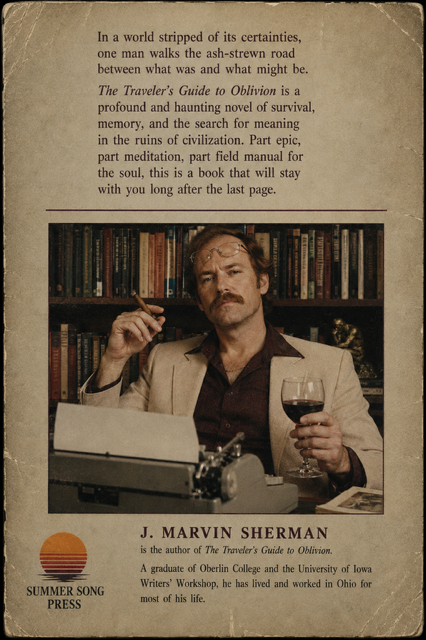
The Original Book cover
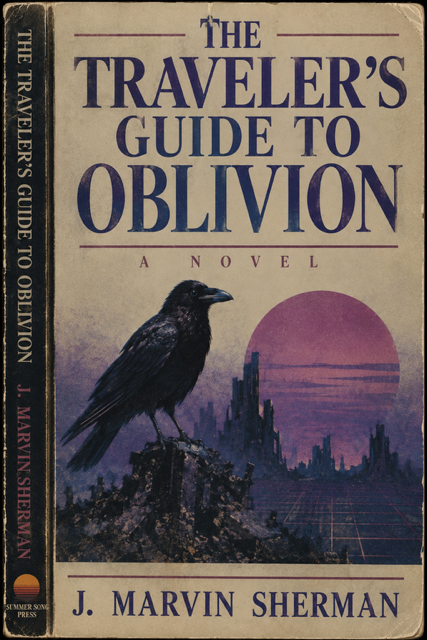
Chapter summary and synopsis
Explore the strange, often bewildering journey of Sherman’s unnamed traveler, from the desolate wasteland to the novel’s famously ambiguous conclusion in this exclusive critical chapter summary.
Chapter 1 — Reflections Upon Waking
The Traveler wakes beside the Detroit River and studies his reflection in the polished blade of the machete strapped across his back. Dressed in a kilt, flak jacket, fishing hat, and ammunition bandolier despite owning no gun, he begins another day arguing with the unseen Esmerelda.
Chapter 2 — A Word Upon a Paper
From his sporran, the Traveler removes a filthy scrap of paper bearing a single penciled word: Baliance. He encounters a stranger who recognizes it as a place and insists that Baliance has everything anyone could ever need.
Chapter 3 — Baliance House
Other Travelers offer conflicting stories about Baliance, sometimes calling it Baliance House. One claims to have lived there until he was banished for bringing in an uninvited guest, although he can no longer remember how to find his way back.
Chapter 4 — Eight Days West
The Traveler sets off in search of Baliance, crossing an implausible distance in an equally implausible number of days and undertaking several errands for strangers along the way. He records and alters information on his scrap of paper with the tiny pencil he keeps in his sporran.
Chapter 5 — News of Esmerelda
A stranger brings astonishing news: Esmerelda has been looking for the Traveler and wants him to meet her at the Eiffel Tower. Unable to cross the sea, he becomes consumed by the possibility that the woman whose voice has accompanied him might actually be waiting.
Chapter 6 — The Elixir
A man claims to possess an elixir capable of transporting its drinker anywhere in the world exactly once. Forced to choose between Paris and Baliance, the Traveler chooses Baliance, reasoning that a place containing everything he needs must also contain some means of reaching Esmerelda.
Chapter 7 — The Red Draught
The miraculous elixir proves to be beet juice and makes the Traveler defecate what he thinks is blood. When he finally walks back to his camp, his sporran—and with it his paper, pencil, and possessions—is gone.
Chapter 8 — Banshee
The Traveler joins another wanderer accompanied by a one-legged dog named Banshee, whose most remarkable trick is saying the words “kill me.” When Banshee’s owner inexplicably disappears, the Traveler accepts the dog as his temporary companion.
Chapter 9 — The Poppy Field
Banshee runs away and the terrified Traveler pursues him into a field of poppies. Starving, he eats carrots and mushrooms growing nearby and soon discovers that the mushrooms have left him violently ill and unable to move.
Chapter 10 — Corvus
As the paralyzed Traveler waits helplessly for death, a crow lands upon his stomach to await its meal. The narrative abandons him for an exhaustive examination of the anatomy of crows, the anatomy of ravens, and the biological distinctions between the two.
Chapter 11 — Corvus, Continued
The discussion of crows and ravens continues long after any reasonable reader might expect it to end. By the time the narrative finally returns to the Traveler, the bird is gone and he is somehow feeling considerably better.
Chapter 12 — The Town Beneath the Earth
The Traveler reaches an abandoned mining town, where he inexplicably discovers his stolen sporran. Among the ruins he encounters a succession of strange inhabitants before hearing someone deep inside the mine calling him by a name the reader is never permitted to learn.
Chapter 13 — The Voice in the Mine
Following the voice underground, the Traveler becomes hopelessly lost. A cave-in seals his path, the air grows thin, and he concludes that the journey to Baliance will end with his suffocation beneath the earth.
Chapter 14 — The Pixie
A pixie appears in the darkness and offers to reveal the meaning of life in exchange for a kiss. The Traveler accepts her bargain, only to receive an elaborate Latin poem whose recurring invocation is Atrō te benedico.
Chapter 15 — The Lesson
The pixie demands that the Traveler repeat the poem until he knows it perfectly. The complete poem is reproduced ten times as he recites it again and again, after which the pixie laughs, steals every piece of his clothing, and abandons him.
Chapter 16 — Oblivion Beneath the Earth
Naked and suffocating, the Traveler feels death approaching until a blink reveals a distant light and a passage that was not there before. He crawls from the mine and collapses beneath the open sky.
Chapter 17 — Banshee Again
The Traveler wakes fully clothed in the poppy field, apparently revealing everything since the mushrooms to have been a hallucination. Banshee defecates in front of him; moments later his missing owner emerges from the woods, collects the dog, and disappears without explanation.
Chapter 18 — A Light That Still Changes
Continuing alone, the Traveler climbs a water tower hoping to glimpse the road to Baliance. He sees only endless ruins—and, several miles away, a functioning traffic light that he inexplicably decides is not worth investigating.
Chapter 19 — Things Returned
The Traveler resumes his journey and, without explanation, once again possesses the sporran supposedly recovered during his mushroom hallucination. The little pencil likewise continues its habit of disappearing and returning without regard for where the narrative last left it.
Chapter 20 — The Humming Man
Abandoning his search for a time, the Traveler joins a wandering band despite being unable to play an instrument and contributes by humming along with its songs. One morning he wakes to discover that the musicians have departed without him.
Chapter 21 — Inventory of a Life
The Traveler returns to the road and accumulates a new steak knife, a pressed rose, a photograph of Abraham Lincoln, and an unlabeled 45 rpm record. He becomes increasingly preoccupied with hearing whatever has been preserved on the mysterious disc.
Chapter 22 — The Man With the Phonograph
An old man possesses a phonograph but no records, while the Traveler possesses a record but no phonograph. The two spend an extraordinary amount of time arguing over whether either man’s useless possession becomes less useless when combined with the other’s.
Chapter 23 — Five Minutes of Music
The old man finally grants the Traveler five minutes with the phonograph. Ten seconds of an achingly beautiful operatic aria emerge before the needle scratches and breaks, prompting the enraged old man to smash the record and hurl its pieces at his guest.
Chapter 24 — The Pieces of the Song
The Traveler spends a chapter collecting every fragment of the shattered record and arranging the pieces into increasingly elaborate shapes. While staring at them, he hears a voice tell him that the road to Baliance has always been before him and that he need only keep walking instead of allowing the world to distract him.
Chapter 25 — Over the Next Hill
Certain that Baliance lies just beyond the next rise, the Traveler runs over one hill only to find another, and another, and another. His certainty becomes desperation until he charges over one final hill and falls, breaking his leg.
Chapter 26 — The Raven
Crows gather around the injured Traveler, but one begins to speak and insists that it is a raven. The Traveler and the bird spend the chapter arguing about the distinction until pain and exhaustion finally cause the Traveler to lose consciousness.
Chapter 27 — The Woman Who Does Not Speak
The Traveler wakes to discover a silent woman caring for him. She feeds and bathes him, sets his broken leg, fashions crutches for him, and then moves him to tears by singing the same aria he heard on the destroyed record.
Chapter 28 — A House Without Words
The woman seduces the Traveler, and for the first and only time in his journey he becomes content. Communicating only through sign language that he inexplicably understands, she promises to become his wife.
Chapter 29 — Figs for a Dress
The Traveler overhears his supposedly mute wife speaking normally with another Traveler while attempting to trade a basket of figs for fabric for a new dress. She disappears over a hill with the stranger and later returns still carrying the figs, while the narrative offers no explanation of what was exchanged or why she will speak to others but never to her husband. Most readers (probably correctly) assume she traded sex for the fabric because she’s still got the figs.
Chapter 30 — Years Without Counting
Their life passes in a dreamlike montage in which the woman ages with impossible speed and the Traveler eventually sees white hair reflected back at him from a river. Whether years have passed, his injured body is feverish somewhere else, or time itself has become unreliable is never resolved.
Chapter 31 — The Grave
The woman dies and the Traveler buries her. He leaves her grave and resumes the journey toward Baliance, after which the woman who became his wife is never mentioned or thought of again.
Chapter 32 — A Treatise Upon Nets
The Traveler attempts to make a fishing net. He fails repeatedly and at considerable length.
Chapter 33 — Geronimo
In another abandoned town, the Traveler befriends a squirrel and names him Geronimo. The companionship briefly gives him another reason to linger rather than continue toward Baliance.
Chapter 34 — This Is Not My Squirrel
Without warning, the narrative shifts into first-person present tense. I meet a stranger who tells me Geronimo belongs to him, and when he commands the squirrel to perform a somersault, Geronimo obeys; I say goodbye to my friend and continue alone.
Chapter 35 — Due East
The narration returns to third person without acknowledging the change. Beside abandoned railroad tracks, the Traveler discovers graffiti on a railcar declaring: “Baliance, due east. The conductor will tell you the code to enter.”
Chapter 36 — Waiting for the Conductor
The Traveler waits for a train despite having no reason to believe trains still run, devoting much of his vigil to increasingly abstract speculation about destinations, departures, and whether waiting itself can constitute travel. Eventually, impossibly, a train arrives.
Chapter 37 — The Train Without a Man
The Traveler boards and moves from car to car in search of the conductor, finally reaching an empty engine. The unmanned train begins moving on its own, accelerating toward a tunnel while every control the Traveler tries fails to stop it.
Chapter 38 — The Tunnel
The train stops abruptly inside the tunnel and refuses to move again, forcing the Traveler to continue on foot among rats and bats. As the darkness becomes absolute, he wonders whether he is dreaming—or whether he never escaped the mine at all.
Chapter 39 — Another Kiss
The Traveler calls for the pixie and promises her another kiss if she will return. He recites the Latin poem she supposedly taught him during the hallucination, but no answer comes, and at last he lies down in the darkness to sleep.
Chapter 40 — 55-2053
Daylight fills the tunnel when the Traveler awakens, revealing graffiti on the wall: “The code is 55-2053.” Remembering the promise that a conductor knows the code to Baliance, he commits the number to memory and walks into the daylight.
Chapter 41 — Over the Next Hill
Certain that Baliance lies just beyond the next rise, the Traveler runs over one hill only to find another, and another, and another. His certainty becomes desperation as he continues running toward a destination he knows must finally be near. Of note, the text of this chapter is word for word identical to Chapter 25. No one knows if this is intentional or not.
Chapter 42 — After the Hill
The repeated narrative abruptly stops before the fall that previously broke the Traveler’s leg and proceeds as though nothing unusual has happened. He continues east, increasingly exhausted and increasingly unable to reconcile the stories he has been told with a world containing no evidence that Baliance exists.
Chapter 43 — The Absence of Esmerelda
The Traveler wanders onward with his destination reduced almost to an act of faith. Esmerelda, once the subject of his love, arguments, and plans to cross an ocean, has by now disappeared completely from his thoughts without the Traveler or narrator ever acknowledging her absence.
Chapter 44 — A Sign From God
Near the end of his strength, the Traveler finally admits that Baliance may never have existed and that everyone who sent him toward it may have lied. He begs God for a sign and receives only the silence of the wasteland.
Chapter 45 — On the Meaninglessness of Meaning
The Traveler descends into an extended stream of consciousness about nihilism, presenting familiar philosophical arguments as personal revelation: if life possesses no inherent meaning, perhaps life is worthless—or perhaps man is therefore free to create meaning and value for himself. He cannot decide which conclusion is true.
Chapter 46 — The Circle
The Traveler’s life flashes before him as the people and creatures of his journey appear in a vision and angrily accuse him of having learned nothing from them. They form a circle around him, turn as one, and point toward the same distant horizon.
Chapter 47 — Baliance
The Traveler rises, crosses another hill, and finally sees Baliance: an enormous sign standing alone above the wasteland. Beyond hunger and pain, he races to it, climbs the billboard ladder, falls, climbs again, and reaches the platform to discover that years of grime conceal most of what is actually written there.
Chapter 48 — Everything You Need
The Traveler destroys his shirt scrubbing the sign and continues with his bare hands until they are cut and bleeding, finally revealing: BIG DEAL APPLIANCE WAREHOUSE — We have everything you need. Call 1-800-555-2083 for your discount code. Baliance was never a place, and the mysterious 55-2053 was merely part of the telephone number; the Traveler screams at the sky, looks across the wasteland, turns his back on the sign, and walks to the edge of the platform. As the aria begins again, he recites the pixie’s poem one final tim, he raises his foot, smiles, and steps forward.
END
What does and doesn’t happen in the book
In a post-apocalyptic America where civilization has collapsed and the past is little more than a fading memory, a nameless wanderer known only as the Traveler sets out in search of Baliance, a mysterious sanctuary rumored to possess everything a person could ever need.
Armed with a machete, a scrap of paper, and a collection of increasingly peculiar possessions, the Traveler crosses a desolate landscape populated by eccentric strangers, inexplicable creatures, and people who appear and disappear without warning. Along the way, he encounters a talking dog, a mysterious pixie, a silent woman, an unmanned train, and a succession of seemingly pointless diversions that repeatedly pull him away from his destination.
As his journey unfolds, the boundaries between reality, hallucination, memory, and imagination begin to dissolve. Objects vanish and reappear. Time behaves unpredictably. Entire episodes seem to contradict what came before. Even the Traveler’s own identity becomes increasingly uncertain.
Beneath its sprawling digressions, bizarre encounters, and often maddening philosophical arguments lies a deceptively simple question: If the thing that gives your life purpose turns out not to exist, does anything you’ve experienced along the way still matter?
Part post-apocalyptic odyssey, part existential meditation, and part bewildering literary experiment, J. Marvin Sherman’s 1982 novel has inspired decades of debate over whether it is an unrecognized masterpiece—or simply hundreds of pages of spectacularly undisciplined writing.
The Poem
Buried within the pages of The Traveler’s Guide to Oblivion is a mysterious poem whose words took on a sinister new meaning in the hands of a killer.
Iter ipsum est quaestio,
Per umbras veritas latet.
Atrō te benedico,
Tenebrae donum ferunt.

Opus non perfectum,
Nec umquam finis aderit.
Omnia amplectere,
Nihil est nihil.
The journey itself is the search.
Through shadows, truth lies hidden.
I bless you with darkness.
The shadows bring a gift.

The work is unfinished.
Nor will the end ever come.
Embrace everything.
Nothing is nothing.
Transcript of FBI Interview: Brenda Lamb
Following the revelations surrounding Derrek Sidney and the Deadwater Lake murders, FBI Special Agent Karen Maven interviewed J. Marvin Sherman’s daughter, Brenda Lamb, about her father’s life, his correspondence, and his possible connection to Sidney.
Click to Read the Transcript
The Grindset Podcast Interview with Brenda Lamb
J. Marvin Sherman’s daughter, Brenda Lamb was invited to sit down with the host of The Grindset, a gaming podcast, to discuss her father’s unusual literary legacy and the cult following his novel inspired.
Content Warning: The Grindset takes an irreverent, sometimes provocative approach to its subject matter. This recording contains strong language and humor that may not be suitable for all listeners.